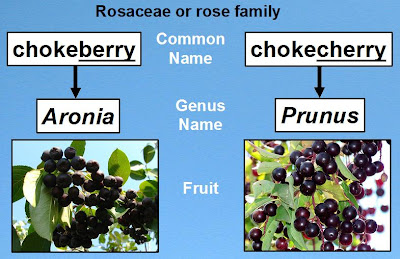
Black chokeberry is one of the common names for Aronia melanocarpa. The name “chokeberry” can easily be misunderstood or misread as the word “chokecherry.” Chokecherry is the common name for a different plant -- . In fact, the two plants are only distantly related within the Rosaceae or rose family of plants. These two species have some similarities but many differences. For example, chokecherry has toxicity issues but chokeberry does not.
Tuesday, March 22, 2011
Sunday, March 13, 2011
Health benefits of aronia berries
According to ChooseMyPlate.gov, a website of the United
States Department of Agriculture (USDA), people who eat more fruits and vegetables
as part of an overall healthy diet are likely to have a reduced risk of some
chronic diseases. A diet rich in fruits and
vegetables may reduce the risk of heart disease, certain types of cancers,
obesity, type 2 diabetes, kidney stones, bone loss, and high blood pressure.
Laboratory tests have shown that aronia berries are higher in antioxidants than apples, bananas, blackberries, blueberries, cherries, cranberries, elderberries, grapes, oranges, pears, prunes, raspberries, and other fruits that are commonly grown commercially in the United States and Canada. For example, the Oxygen Radical Absorbency Capacity (ORAC) values for raw aronia berries (chokeberries) is 16,062 compared to 6,552 for raw blueberries. The bar graph below shows the ORAC values for several fruits.
Thursday, March 10, 2011
Aronia plants for sale
Would you like to buy some aronia plants? Would you like to plant them in your garden so you can harvest your own aronia berries? If so, you are not alone. Start by choosing a reputable nursery or garden center that sells high-quality plants. Three of the mail-order nurseries that I recommend are discussed in this blog. (We do not sell aronia plants.) Please let us know if there are other sources of aronia plants that you like.
If you already have one or more aronia plants, you can propagate those plants by vegetative methods. Aronia cultivars, such as Viking and Nero, are most often propagated by vegetative methods. This includes propagation by semi-hardwood and hardwood stem cuttings, layering, and micropropagation. You can also dig-up and transplant young suckers at the base of clump.
Aronia cultivars can also be grown from seed. Because they produce a high percent of apomictic seed, they will come true from seed. Most cultivars are also nearly seedless, so it is difficult to get many seed. This post includes advice about how to grow aronia plants from seeds (read the post entitled "Aronia seeds for sale").
If you already have one or more aronia plants, you can propagate those plants by vegetative methods. Aronia cultivars, such as Viking and Nero, are most often propagated by vegetative methods. This includes propagation by semi-hardwood and hardwood stem cuttings, layering, and micropropagation. You can also dig-up and transplant young suckers at the base of clump.
Aronia cultivars can also be grown from seed. Because they produce a high percent of apomictic seed, they will come true from seed. Most cultivars are also nearly seedless, so it is difficult to get many seed. This post includes advice about how to grow aronia plants from seeds (read the post entitled "Aronia seeds for sale").
| Choose healthy plants from reputable sources |
Wednesday, March 9, 2011
How to use aronia berries
You can use aronia berries in many different ways. You can grow your own aronia plants in your home garden and harvest your own aronia berries. The berries will be ripe in late summer or early fall. Then you can pick the berries and eat them fresh off the bush either raw or processed in many different ways. You can also dry or freeze the berries for later use. Fresh, dried, or frozen aronia berries can be used in many different ways.
If you don't want to do it yourself, then you can purchase many different commercial products made from aronia berries. There are several ads on this website for businesses that sell aronia berry chews, powders, supplements, and dried or dehydrated aronia berries. When you try these products you may be surprised to find out how easy it is to get the remarkable health benefits of aronia berries in your daily diet.
To view aronia recipes posted on other websites, click on the photos in this post or the word "recipes" in this sentence. For a few more recipes click here.
If you don't want to do it yourself, then you can purchase many different commercial products made from aronia berries. There are several ads on this website for businesses that sell aronia berry chews, powders, supplements, and dried or dehydrated aronia berries. When you try these products you may be surprised to find out how easy it is to get the remarkable health benefits of aronia berries in your daily diet.
To view aronia recipes posted on other websites, click on the photos in this post or the word "recipes" in this sentence. For a few more recipes click here.
![]() |
| Aronia bread, wine, soap, jam, & hand cream |
Tuesday, March 8, 2011
What do aronia berries taste like?
Aronia berries and products made from them have a distinctive taste that is unlike any other fruit. The taste of aronia is a complex sensation in the mouth, tongue, and throat. It is difficult to describe the taste of most fruits and berries including aronia. Many people describe the taste of aronia berries as a pleasant, distinctive flavor. If you like other fruits and berries, then you will probably like the taste of aronia berries.
| Ripe aronia berries August 16, 2006 |
Monday, March 7, 2011
Wild aronia plants in the US
After an on-site aronia consultation with clients in Wisconsin , I drove back home to Iowa . Driving along enjoying the scenery, I remembered that southwest Wisconsin is one of the areas where Aronia melanocarpa is native. So I started looking for aronia plants in the rapidly passing landscape. But the identifying characteristics of aronia plants are not distinctive, especially in July. When viewed from a moving vehicle at a distance, identifying aronia plants was nearly impossible. I would need to stop the car and get out for a closer search.
Sunday, March 6, 2011
Grants for specialty crops
Grants are available to help promote specialty crops such as aronia. In most states, grant proposals are due on or before the second week in May . USDA will announce the Specialty Crop Block Grant Program, through the Agricultural Marketing Service (AMS). This is a flow-through program whereby individual states apply for federal funds, which they will use for grants within their states.
![]() |
| Grant funds are available for aronia projects |
Where is aronia grown?
Early in the 20th century, aronia was introduced from the United States into Eastern Europe , Scandinavia , and Russia where high quality, larger fruited cultivars were selected. Thousands of acres of aronia are now grown as a commercial berry crop in Eastern Europe . Countries with notable commercial aronia production include Bulgaria, Czechoslovakia, Denmark, Estonia, Germany, Latvia, Lithuania, Poland, Siberia, and Sweden.
In March 2008, an article written by Vadim Makarenko and published in Poland’s largest daily newspaper, Gazeta Wyborcza, .reported that Polish aronia berry production was 35-40,000 tons. This amounted to 90% of the world production of aronia. Of that, 90 percent was being processed into juice concentrate for export to the US and other countries. Poland itself was using the remaining 10 percent of the fruit. It is estimated that in 2012, about 50 percent of the world’s commercial aronia berry production is inPoland .
In March 2008, an article written by Vadim Makarenko and published in Poland’s largest daily newspaper, Gazeta Wyborcza, .reported that Polish aronia berry production was 35-40,000 tons. This amounted to 90% of the world production of aronia. Of that, 90 percent was being processed into juice concentrate for export to the US and other countries. Poland itself was using the remaining 10 percent of the fruit. It is estimated that in 2012, about 50 percent of the world’s commercial aronia berry production is in
![]() |
| Aronia plantation in Poland |
Friday, March 4, 2011
What is aronia?
Aronia (pronounced "ar-ROH-nee-uh") is one of the common names used for Aronia melanocarpa. It is a perennial, deciduous, self-supporting shrub. Unlike grape vines, aronia does not need trellising. The growth habit of Aronia melanocarpa plants varies greatly. The range of variability extends from ground cover types to tall and leggy shrubs up to 20 feet tall and everything in-between. They also vary considerably in fruit size, color, ripening date, and flavor.
| Dr. Everhart is out standing in the field of aronia |
Where is aronia native?
The two species that are generally recognized in the genus Aronia are A. melanocarpa, black chokeberry, and A. arbutifolia, red chokeberry. Aronia melanocarpa (Photinia melanocarpa) is native to the northeastern one-quarter of the United States. Its native range extends north into Canada and south into the higher elevations of the Appalachian Mountains
in northGeorgia .
in north
![]() |
| Native range of Aronia melanocarpa |
Subscribe to:
Posts (Atom)


